
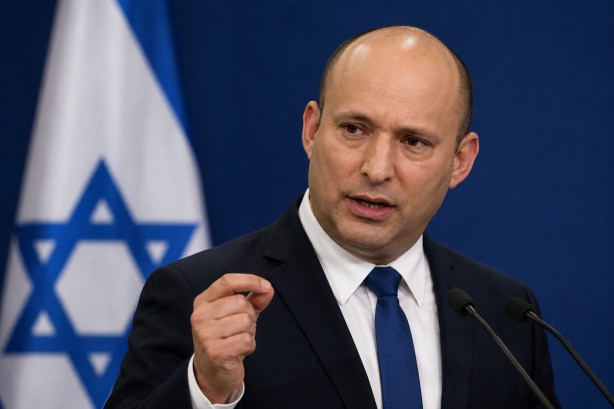
In the lead-up to Israel’s October 27 election, former Prime Minister Naftali Bennett has leveled serious accusations against the current Prime Minister, Benjamin Netanyahu. Bennett claims that Netanyahu is spearheading a divisive political campaign that may heighten the threat of violence against political opponents. In a recent interview tied to the release of a book chronicling his political journey, Bennett criticized Netanyahu’s leadership style as increasingly authoritarian. He also accused media outlets and political networks supportive of Netanyahu of perpetuating hostile rhetoric aimed at his rivals.
Bennett voiced particular concern for Gadi Eisenkot, whom he sees as a significant contender against Netanyahu. He warned that continued political attacks might lead some individuals to perceive opposition politicians as adversaries, potentially inciting violent actions against them. Reflecting on the transition of power in 2021, Bennett recalled Netanyahu cautioning him that forming a coalition government with anti-Netanyahu parties would trigger a fierce political backlash. Bennett admitted he had underestimated the magnitude of the political storm that ensued.
On the topic of Iran, Bennett criticized Netanyahu’s administration for its handling of the country’s burgeoning nuclear capabilities between 2018 and 2021. According to Bennett, his own government, upon taking office, bolstered intelligence, military planning, and preparations, which later facilitated successful Israeli operations against Iranian targets. He implied that these efforts were crucial in addressing the perceived shortcomings of Netanyahu’s approach to Iran.
Bennett has also revised his stance on term limits for Israeli prime ministers, now advocating for them despite previously opposing such measures. With the Israeli election on the horizon, he has expressed a willingness to collaborate with other opposition figures to prevent Netanyahu from securing another term, even if this cooperation requires him to accept a less prominent role in the political landscape.