
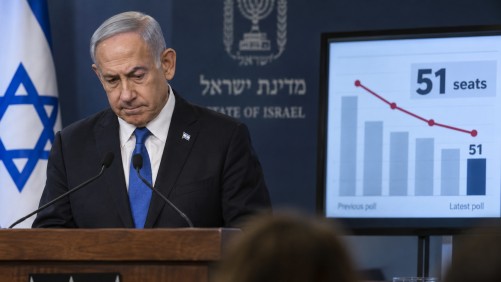
As Israel approaches its October 27 election, a new poll reveals a continuing political stalemate, with neither the ruling nor opposition blocs securing a parliamentary majority. The poll indicates that Prime Minister Benjamin Netanyahu’s political alliance is projected to win 51 seats in the 120-member Knesset, while the main Zionist opposition bloc is expected to capture 55 seats. This leaves both sides short of the 61 seats needed to form a majority government.
The survey highlights the potential influence of two Arab-majority parties, which are predicted to win a combined 14 seats. These parties could play a crucial role in coalition-building efforts as both major blocs struggle to cross the majority threshold. The emergence of new parties is also noteworthy, with former IDF chief Gadi Eisenkot’s Yashar party projected to become the largest single party with 24 seats.
Within Netanyahu’s bloc, the Likud party is expected to secure 22 seats, followed by Shas with 10, United Torah Judaism with nine, Otzma Yehudit with seven, and Religious Zionism with four. Meanwhile, Naftali Bennett’s B’Yachad is projected to gain 14 seats, Yisrael Beytenu nine, and the Democrats eight, indicating a fragmented political landscape.
Several smaller parties, including Ofer Winter’s People of Israel, HaMiluimnikim, and Blue and White, are anticipated to fall below the 3.25% electoral threshold, which would bar them from entering the Knesset. The poll surveyed 500 respondents and has a margin of error of 4.4 percentage points, underscoring the fluidity of Israel’s political scene.
In the event of another electoral deadlock, public opinion appears divided. Approximately 31.4% of those surveyed prefer another election, while 29.6% support the idea of a unity government, and 27% favor a minority government. Among Netanyahu’s supporters, there is a notable inclination towards a unity government, with 45.02% backing this option. Conversely, those opposed to Netanyahu express the strongest support for a minority government at 39.79%.