
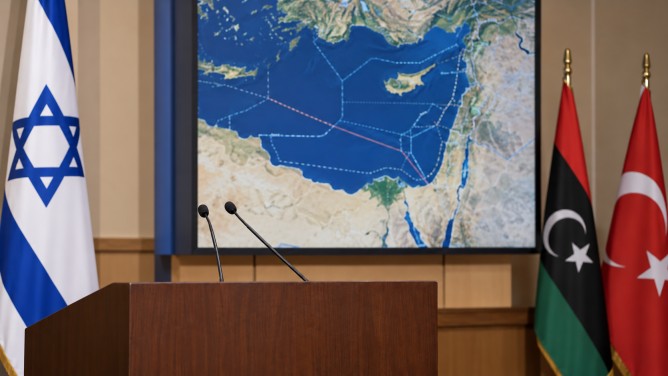
Eastern Libya’s parliament has ratified a maritime agreement with Türkiye, sparking criticism from Israel and other regional actors who fear the deal could compromise maritime rights in the eastern Mediterranean. The agreement delineates boundaries in an area rich in potential natural gas resources and has faced strong opposition from Greece, Cyprus, and Egypt, who claim it conflicts with their maritime zones.
Israel, aligning with Greece and Cyprus, argues that the agreement undermines regional stability and maritime rights. The Israeli Foreign Ministry has accused Türkiye of exacerbating tensions in the eastern Mediterranean, a region where geopolitical dynamics have been increasingly fraught. Relations between Israel and Türkiye have been strained, particularly due to differing stances on issues such as the conflict in Gaza.
The European Union has also voiced concerns, questioning the legal validity of the agreement and underscoring the importance of adhering to international maritime law and respecting the sovereign rights of its member states. Greece has taken the matter to the United Nations, warning that the agreement might disrupt security and stability in the region.
Despite the backlash, Türkiye has defended the agreement, with Foreign Minister Hakan Fidan stating that it is consistent with international law and serves the interests of both Türkiye and Libya. Fidan noted that the Libyan parliament’s approval formalizes a deal Türkiye already regarded as effective.
The situation further highlights the complex political landscape within Libya itself. Eastern Libya, under the influence of military commander Khalifa Haftar, continues to operate in rivalry with the internationally recognized government in Tripoli. Nonetheless, its relations with Ankara have evolved over recent years, adding another layer to the regional dynamics.
As the eastern Mediterranean remains a focal point for energy exploration and geopolitical rivalry, the international community, led by the EU, continues to call for adherence to established maritime laws to prevent further escalation of tensions in the area.